

Maintaining our road networks is a massive, costly challenge. Traditional visual inspections are slow, labor-intensive, and subjective. But what if robots and AI could take over?
A groundbreaking 2022 review by Qureshi et al. explores exactly this frontier. The research dives into how intelligent image analysis and deep learning are automating pavement assessment, offering a faster, cheaper, and more reliable future for infrastructure management.
Why Automate Pavement Inspection?
- Scale: Countries have hundreds of thousands of kilometers of roads to monitor.
- Cost: Manual inspection is expensive and time-consuming. For example, Ireland spends hundreds of millions annually on road maintenance.
- Consistency: Human ratings can be subjective and prone to error.
The AI-Powered Solution
The process mirrors a human inspector, but at machine speed and scale:
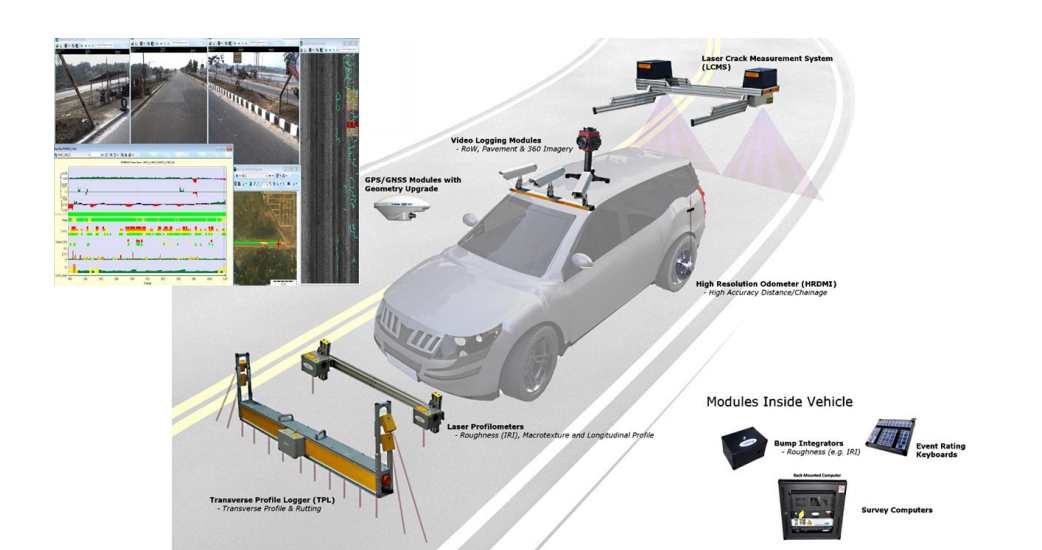
- Data Collection: Specialized vehicles, drones, or even smartphones equipped with cameras and sensors capture road images.
- Distress Detection: AI algorithms—primarily advanced Convolutional Neural Networks (CNNs)—analyze the imagery to identify and quantify defects like:
- Cracks (alligator, longitudinal, transverse)
- Surface Defects (potholes, raveling, bleeding)
- Patches and deformations
- Condition Rating: The AI quantifies the distress data to automatically calculate a standardized pavement condition index (like PCI or PSCI), assigning a health score to each road section.
Robotics & Sensor Synergy
The research highlights how robotics platforms are key, carrying various sensors for optimal data capture:
- Top-Down Views: Laser scanners and downward-facing cameras on vehicles provide high-resolution detail for precise crack measurement.
- Forward-Facing Views: Dashcams offer a wider, cost-effective overview ideal for surveying large networks of local roads.
- Aerial Perspectives: Drones help inspect hard-to-reach areas like airport runways.
The Deep Learning Advantage
While earlier methods used simple image processing, modern systems rely on deep learning for remarkable accuracy:
- Object Detection (using models like YOLO) to locate and classify potholes or cracks.
- Pixel Segmentation (using U-Net architectures) to map the exact shape and extent of damage.
- The best models achieve F1-scores over 0.9, rivaling human experts in detection tasks.
Challenges and the Road Ahead
Despite progress, fully automated rating systems aren’t yet plug-and-play:
- Regional Variation: Distress types and severity look different in Arizona vs. Norway. AI models need local data for training.
- Beyond Cracks: Most research focuses on cracks and potholes. Automating the assessment of other defects like raveling or bleeding is still developing.
- From Detection to Rating: The ultimate goal is a direct, end-to-end pavement score. Current systems often excel at finding defects but are still evolving to perfectly replicate complex regional rating formulas.
The Bottom Line for Robotics
This research underscores a massive opportunity for the robotics industry. Integrating robust AI vision systems into autonomous ground vehicles or UAVs creates a powerful tool for intelligent infrastructure monitoring. The future of pavement management is robotic, data-driven, and continuous, moving us from reactive pothole patching to predictive, smart maintenance.
You can read explanation in more detail at this link: https://www.mdpi.com/1424-8220/22/22/9019